

Key Takeaways
Renault gearbox shifting problems can begin as a small hesitation and develop into a costly failure if ignored. The transmission type, driving symptom, fluid condition, and diagnostic results all matter when choosing the right repair.
- A delayed, harsh, noisy, or slipping shift should be investigated rather than ignored.
- Manual, automatic, dual-clutch, and automated-manual systems fail in different ways.
- Clutch, linkage, fluid, electrical, and internal gearbox faults can feel surprisingly similar.
- Fault-code scans and a controlled road test often prevent unnecessary parts replacement.
- Prompt servicing and correct driving habits can reduce future transmission wear.
Recognizing Renault gearbox shifting problems
Shifting trouble is not always dramatic at first. A vehicle may still move normally while taking longer to engage a gear, making a light clunk, or refusing reverse only when cold. Note when the symptom appears, because temperature, engine load, and the selected gear can help narrow the cause.
A useful first distinction is whether the problem happens while selecting a gear or during the actual change between gears. The timing of the symptom often tells a technician whether to inspect the clutch and linkage, the transmission controls, or the internal gearset first.
Delayed or harsh gear changes
A pause before drive or reverse engages can point toward a control, pressure, clutch, or fluid issue, particularly in an automatic system. A manual gearbox that becomes difficult to shift only after the vehicle warms up may have a different cause from one that is stiff from the first mile.
Harsh changes can also result from incorrect adaptation values, worn mounts, or an engine-control fault rather than a failed gearbox. The sensation should be described precisely: a sharp bump, a flare in engine speed, or a long pause each suggests a different diagnostic path.
Difficulty selecting first, reverse, or neutral
Difficulty selecting first or reverse in a manual vehicle is often related to clutch release, selector cables, or linkage adjustment. If the gear can be selected easily with the engine off but not with it running, the clutch deserves close attention.
An automatic that will not select neutral or reverse should not be forced. A low fluid level, electrical problem, hydraulic fault, or internal failure may all produce a similar result, so the vehicle should be checked before continued driving creates more damage.
Gear slipping, jumping, or losing drive
Slipping occurs when engine speed rises without a matching increase in road speed. In a manual vehicle, a worn clutch is a common possibility; in an automatic or dual-clutch system, clutch packs, hydraulic pressure, actuators, or control signals may be involved.
A gearbox that jumps out of gear can have worn engagement components, a damaged synchronizer, or a linkage that is not fully selecting the gear. Losing drive altogether is a safety concern, especially when joining traffic or climbing a hill.
Grinding, whining, or clunking noises
Grinding during one particular gear change often suggests synchronizer or clutch-release trouble. A noise that rises with vehicle speed may instead come from bearings, gears, or a differential, while a whine that changes under acceleration and coast can help locate the load-related fault.
Clunks are not automatically evidence of internal gearbox damage. Worn engine or transmission mounts, loose linkage parts, and driveline play can transmit a similar knock through the cabin. A technician should listen during both static checks and a road test.
Warning lights and dashboard messages
A warning light or transmission message means the vehicle has detected an abnormal signal or operating condition, not necessarily that the entire gearbox must be replaced. The stored code, freeze-frame information, battery voltage, and wiring condition all need to be considered.
If the vehicle enters a fixed gear or reduced-performance mode, avoid treating it as a normal driving mode. It may allow a short trip to a repair facility, but repeated driving can turn a manageable fault into a larger mechanical repair.
Common causes by transmission type
The same complaint can have very different causes depending on whether the vehicle uses a manual, conventional automatic, dual-clutch, or automated-manual transmission. Fluid specifications and checking procedures also vary, so a generic top-up is not a safe solution. Start with the exact transmission identification and service information.
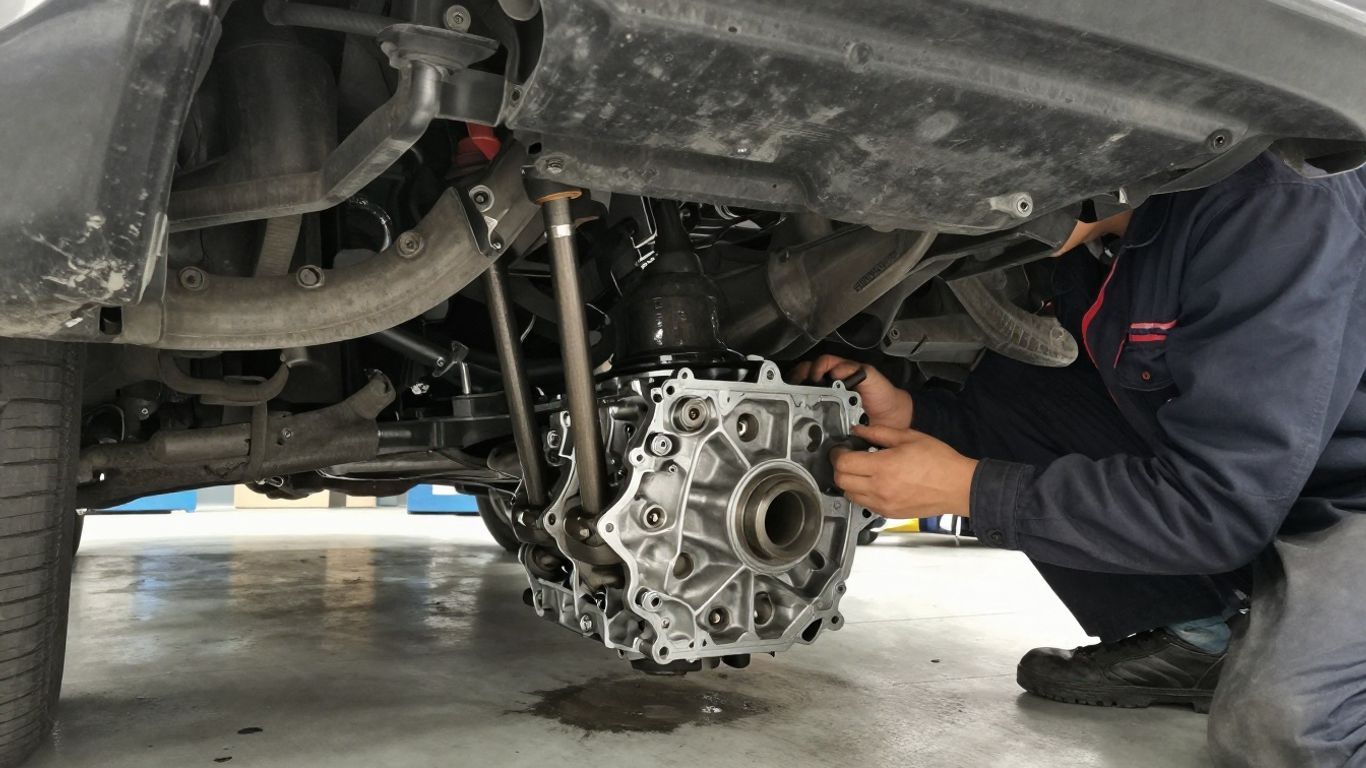
The following image illustrates the kind of under-vehicle inspection that can reveal leaks, damaged housings, and linkage issues.
Manual gearbox clutch and linkage faults
A manual gearbox may be mechanically healthy while the clutch fails to release fully. A worn clutch disc, pressure plate, release bearing, hydraulic cylinder, or cable can make first and reverse difficult to select and may cause gear grinding.
Selector cables and external linkage can stretch, seize, or lose adjustment. Since these parts are usually easier to inspect than the internal gearset, they should be checked before assuming that the gearbox needs rebuilding.
Automatic transmission fluid and hydraulic issues
Automatic transmissions depend on the correct fluid level, condition, temperature, and hydraulic pressure. Leaks, degraded fluid, a restricted filter, or a valve-body problem can produce delayed engagement, harsh shifts, slipping, or a failure to select a gear.
Fluid should be inspected using the manufacturer’s prescribed method. Some systems require a specific temperature range and level procedure, so checking it casually on a cold driveway may give a misleading result.
Dual-clutch transmission actuator problems
A dual-clutch transmission uses electronically controlled actuators to operate its clutch and gear-selection functions. An actuator fault, clutch wear, wiring issue, or incorrect adaptation can cause hesitation, juddering, harsh engagement, or a loss of drive.
The repair decision should be based on measured values and fault codes rather than the symptom alone. A clutch replacement and an actuator replacement can feel similar from the driver’s seat but require different work.
AMT calibration and software faults
An automated manual transmission combines a manual gearbox with automated clutch and gear operation. Calibration errors, low system voltage, position-sensor faults, or lost learned values can prevent smooth engagement even when the basic gears and clutch are serviceable.
After mechanical work, the system may need a prescribed initialization or clutch-learning procedure. Skipping that step can leave the vehicle shifting poorly and may make a successful repair appear unsuccessful.
Wear in synchronizers, bearings, and gears
Internal wear becomes more likely when one gear consistently grinds, jumps out, or produces a speed-related noise. Synchronizers can lose their ability to match shaft speeds, while bearings and gear teeth may become noisy or damaged.
Internal repair is more involved than replacing an external component. A proper estimate should account for the source of the wear, the condition of related parts, and whether the gearbox casing contains metal debris.
Renault models and components often involved
Model names alone do not identify the fault. The same Renault model may have been sold with different engines, gearboxes, software versions, and clutch arrangements across different years and markets. The vehicle identification number and transmission code are more useful than a general internet symptom list.
Owner reports can help describe a recurring symptom, but they should not replace testing. For example, a Renault Scenic gearbox guide can help a driver recognize terminology around delayed engagement, slipping, and electronic control faults without proving that a particular car has one of those failures.
Common issues in Renault Clio gearboxes
A Clio with a manual gearbox may develop clutch or linkage symptoms, while an automated or automatic version requires attention to its hydraulic, electronic, and actuator systems. The exact behavior—hard selection, judder, slipping, or a warning message—is more informative than the model name by itself.
Check whether the fault affects every gear or only one selection. A problem limited to reverse, for instance, may direct the inspection toward clutch release or selector operation rather than a complete gearbox failure.
Renault Scenic and Mégane transmission concerns
Scenic and Mégane vehicles have appeared with several transmission configurations, so diagnosis must begin by confirming which system is installed. Manual versions tend to direct attention toward the clutch and selector mechanism, while automated systems add actuators, control units, and calibration procedures.
Fluid leaks and intermittent electrical faults can be especially confusing because the vehicle may shift normally for part of a journey. Record the conditions under which the fault returns, including temperature, traffic, and whether the battery has recently been disconnected.
Renault Captur and Kadjar shifting faults
Captur and Kadjar shifting complaints can involve either a conventional manual arrangement or an electronically managed system, depending on specification. A hesitation during low-speed maneuvering should be separated from a fault that occurs during higher-speed upshifts.
Do not assume that a jerky launch means the same thing as a delayed gear change. One may involve clutch control or adaptation, while the other may involve fluid pressure, sensors, or a mechanical selector problem.
Renault Master commercial vehicle gearbox problems
A Master used for deliveries, towing, or frequent stop-start work may place heavier demands on the clutch, gearbox, and driveline than a lightly used passenger car. Loading, hill starts, and repeated maneuvering can expose a marginal clutch or actuator sooner.
Commercial drivers should report whether the fault appears only when loaded, after extended idling, or during repeated reversing. A specialist diagnostic approach is particularly useful for automated systems, where generic code readers may not access every transmission function.
Differences between manual, EDC, and automatic systems
A manual system depends directly on the driver’s clutch and selector movements. An EDC or other dual-clutch arrangement uses electronic control and actuators around a manual-style gearset, while a conventional automatic uses hydraulic control and automatic clutch or brake elements.
These differences affect both diagnosis and repair cost. A clutch pedal complaint points toward one set of checks, whereas a stored actuator code or a pressure-related symptom calls for a different test plan.
How to diagnose a shifting problem
Good diagnosis is a process of elimination, not a guess based on the most alarming symptom. Begin with the driver’s description, verify the transmission type, inspect for obvious mechanical problems, and then use scan data and a controlled road test. That sequence helps prevent replacing expensive components unnecessarily.
The inspection should also consider battery condition, engine faults, fluid leaks, and recent work. Transmission controls often depend on stable voltage and accurate signals from other vehicle systems.
Questions to ask before testing the vehicle
Ask when the issue began, whether it is constant, and whether the vehicle was recently serviced or had a battery problem. Also ask whether the fault appears when cold, when hot, under acceleration, during parking maneuvers, or only with a heavy load.
The most useful answers are specific rather than general. “It slips” is less helpful than “the engine rises by 1,000 rpm during the 2–3 shift after the vehicle is warm.”
Checking fluid level, condition, and leaks
Inspect for wet areas around seals, driveshafts, the transmission pan, cooler lines, and housing joints. Fluid color and odor can provide clues, but they cannot by themselves confirm a failure or justify a rebuild.
Use only the specified fluid and the correct level-setting procedure. Mixing fluids or filling to an assumed level can create a new shifting fault. A general automatic transmission diagnosis guide may help explain terms such as limp mode and delayed engagement, but the vehicle still needs model-specific testing.
Inspecting the clutch, cables, and linkage
On a manual vehicle, inspect clutch pedal travel, hydraulic leaks, release operation, selector cables, bushes, and external levers. The linkage should move through its range without binding, excessive play, or contact with nearby components.
For an automated system, inspect actuator connections and mounting points as well as the underlying clutch mechanism. Mechanical resistance can overload an actuator and make an electrical fault appear to be the original problem.
Reading transmission fault codes
A proper scan should record current and stored transmission codes, live data, system voltage, and relevant freeze-frame conditions. Codes are clues about a monitored circuit or operating condition; they are not automatic instructions to replace the named part.
Clear codes only after recording them and completing the necessary tests. If a fault returns immediately, that behavior may help distinguish a hard electrical failure from an intermittent mechanical or temperature-related issue.
Using a road test to reproduce the symptom
A road test should be planned and safe, with attention to shift timing, engine speed, vehicle speed, temperature, throttle position, and selected gear. The technician should reproduce the complaint without deliberately abusing the clutch or transmission.
A short video or carefully written log can be useful when a fault is intermittent. For complex automated systems, a specialist may also monitor actuator position, clutch slip, and commanded versus actual gear selection during the test.
The road-test result should be compared with the scan data and physical inspection. If those three sources point in different directions, more testing is usually cheaper than guessing.
Repair options and likely costs
Repair pricing depends on access, parts availability, transmission design, and the amount of internal damage. A simple linkage adjustment can be relatively modest, while a clutch, actuator, or gearbox replacement can involve substantial labor. Ask for a written estimate that separates diagnosis, parts, labor, fluids, programming, and any required follow-up.
Before approving major work, confirm whether the proposed repair addresses the tested cause. Decisions about repair versus replacement benefit from the same practical comparison of condition, budget, timeline, and long-term value found in this repair decision guide, even though the subject matter there is different.
Adjusting or replacing the gear linkage
If cables, bushes, levers, or selector brackets are worn or misadjusted, repair may restore clean gear selection without opening the gearbox. The technician should verify the adjustment in every gear and check that the original cause of the misalignment has not damaged the selector mechanism.
Replacement is more appropriate when a cable is seized, a bush has excessive play, or a mounting point is damaged. A road test should follow the work to confirm that the fault was not masking a clutch or internal problem.
Servicing the clutch and dual-mass flywheel
A clutch repair may include the disc, pressure plate, release bearing, hydraulic components, and, where fitted, the dual-mass flywheel. Replacing only the visibly worn piece can be false economy if related parts are already near the end of their service life.
The flywheel should be assessed for excessive movement, hot spots, noise, and surface damage. The final scope depends on inspection rather than on mileage alone.
Changing transmission fluid and filters
Fluid and filter service can help when the fault is linked to contamination, incorrect level, or neglected maintenance. It cannot repair broken gears, a failed actuator, or a severely worn clutch, so expectations should remain realistic.
The service record should state the fluid specification, quantity, temperature or level procedure, and whether adaptations were checked afterward. A partial service may be appropriate for one transmission but unsuitable for another.
Repairing solenoids, actuators, or valve bodies
Solenoids, actuators, and valve bodies can sometimes be tested or repaired separately instead of replacing the complete transmission. The right option depends on fault-code confirmation, hydraulic measurements, electrical testing, and the condition of the surrounding components.
After installation, many electronically controlled systems require coding, calibration, or a relearn procedure. A repair that omits those steps may leave the original shifting behavior unchanged.
Rebuilding or replacing the gearbox
A rebuild may be justified when internal wear is confirmed and the casing, shafts, and major components are suitable for refurbishment. Replacement with a verified unit can reduce downtime, but its history, warranty, fluid requirements, and compatibility should be documented.
A final estimate should include removal and refitting, seals, fluid, programming, and post-repair testing. For a commercial vehicle, downtime and recovery costs may matter nearly as much as the gearbox price itself.
Preventing future gearbox shifting faults
Prevention is mostly consistent maintenance and early attention, not a special driving trick. Keep service records, use the correct consumables, and treat a small change in shift quality as useful information. This is particularly valuable when a vehicle is used heavily in traffic, on hills, or while carrying loads.
A sensible maintenance plan also leaves room for age-related wear. Even a well-serviced transmission can eventually need clutch, seal, bearing, or actuator work.
Following the correct fluid service schedule
Follow the service interval and fluid specification for the exact transmission, including any temperature-based level checks. Do not assume that a fluid marketed for one automatic or dual-clutch system is suitable for another.
Check for leaks during routine servicing and investigate a falling level promptly. A small leak can become a pressure problem before a large stain appears on the ground.
Using the clutch and selector correctly
Avoid resting a hand on the selector, holding a vehicle on a hill with clutch slip, or keeping the clutch partially engaged in slow traffic. Use the parking brake where appropriate and allow the clutch to engage cleanly.
Do not force a resistant gear. Pause, return to neutral, and have the clutch and linkage checked if the resistance keeps returning.
Responding quickly to warning signs
A new whine, delayed engagement, burning smell, judder, or warning message deserves attention while the vehicle still drives. Early diagnosis may limit the repair to an external, fluid, or control issue rather than allowing continued wear inside the gearbox.
Keep a record of the symptom and avoid clearing warning lights before a scan. The stored information may disappear or become less useful after repeated resets.
Updating transmission software and calibration
Software updates and calibration procedures should be considered when the manufacturer’s service information identifies them as relevant to the symptom. They are not a substitute for checking fluid, wiring, clutch condition, and mechanical operation.
After a battery replacement or transmission repair, confirm whether learned values need to be reset or relearned. The correct procedure depends on the transmission and diagnostic equipment used.
Knowing when professional inspection is necessary
Stop driving and arrange professional help if the vehicle loses drive, selects the wrong gear, leaks heavily, smells of burning fluid, or repeatedly enters reduced-performance mode. Continuing may create a dangerous situation or increase the repair bill.
Choose a workshop that can identify the transmission, access its fault codes, perform mechanical and hydraulic checks, and explain the evidence behind its recommendation. If you are comparing repair providers, transparent pricing and documented work matter more than a confident guess; even general social media management services are built around tracking results rather than relying on assumptions, though that principle is separate from vehicle repair.
Conclusion
Renault gearbox shifting problems can come from a clutch, linkage, fluid system, actuator, software calibration, or internal gearbox wear. A careful symptom record, correct scan, physical inspection, and controlled road test give the best chance of choosing a proportionate repair instead of replacing parts by guesswork.
Frequently Asked Questions
What is the most common cause of difficult gear selection?
On a manual vehicle, clutch-release problems and worn or misadjusted linkage are common possibilities. Automatic systems may instead involve fluid level, hydraulic pressure, sensors, or control components.
Can low transmission fluid cause harsh shifting?
Yes. Low or degraded fluid can affect hydraulic pressure and clutch operation in systems that depend on it. The source of the loss should be found, and the level must be checked using the correct procedure.
Is a gearbox warning light always a sign of major damage?
No. A warning may be triggered by a sensor, wiring fault, low voltage, software issue, or control problem. A scan and supporting tests are needed before judging the severity.
Why does a manual gearbox grind when selecting reverse?
Reverse often lacks the same synchronizing arrangement as forward gears. Grinding may occur when the clutch is not fully releasing, the linkage is misadjusted, or internal components are worn.
Can a transmission problem be fixed with a software update?
Sometimes calibration or software is relevant, especially in electronically controlled systems. It will not correct a worn clutch, damaged gear, failed bearing, fluid leak, or mechanical linkage fault.
Should I keep driving if the vehicle slips between gears?
It is safer to limit driving and arrange an inspection. Continued slipping generates heat and wear, and a sudden loss of drive can create a traffic hazard.
Is rebuilding better than replacing a gearbox?
Neither option is always better. The decision depends on confirmed damage, the condition of the casing and internal parts, replacement-unit history, warranty, downtime, and total installed cost.