Key Takeaways
A warning light is a starting point, not a diagnosis. Note how the light behaves, check the vehicle’s symptoms, then read the stored fault data before replacing parts.
- A steady light usually allows a cautious trip for diagnosis, while a flashing light can indicate an urgent misfire.
- Dashboard messages and driving symptoms help establish how serious the fault may be.
- An OBD2 scan should record codes before anything is cleared.
- Fault codes point toward a system, but testing is still needed to identify the failed part.
- A repair is not complete until the vehicle is rescanned and road-tested.
What the Renault engine warning light means
The amber engine-shaped warning light generally means that the engine-management or emissions system has detected an irregular reading. It does not identify one particular component on its own. The most useful first step is to combine the symbol with the message on the dashboard and the way the car is running. A Renault warning-light guide can help identify related dashboard symbols, but the vehicle’s stored codes remain central to diagnosis.
Difference between a steady and flashing warning light
A steady light normally indicates a fault that should be investigated soon, even if the car still feels normal. A flashing light is more concerning because it can accompany an active misfire, which may overheat and damage the catalytic converter. Reduce load, avoid hard acceleration, and stop when it is safe if the engine is shaking, losing power, or producing unusual smells.
How the light relates to emissions and engine management
The engine computer monitors combustion, air measurement, fuel delivery, and emissions equipment. A deviation can illuminate the warning light even when there is no obvious mechanical noise. Problems with an oxygen sensor, injector, intake leak, exhaust component, or electrical supply can therefore produce similar dashboard symptoms.
Common dashboard messages that appear with the warning light
Messages vary by model, engine, and equipment, but wording may refer to injection, emissions, engine management, or a general engine fault. Treat a message such as “check injection” as a direction to scan and test, not proof that an injector is defective. A separate red stop, oil-pressure, or overheating warning changes the situation and calls for immediate attention.
Why the warning light may turn off by itself
If the computer no longer detects the condition during later drive cycles, the light may switch off while the code remains stored or pending. That does not prove the underlying issue has gone away. Record when it appeared, whether the engine was cold or hot, and what happened immediately beforehand; intermittent faults are often easier to find with that context.
Check the warning light and vehicle symptoms first
Before connecting a scanner, observe the vehicle as carefully as you can. A warning light accompanied by rough running, smoke, fluid loss, or a serious dashboard message deserves more urgency than an isolated light on an otherwise normal drive. This first inspection also gives meaning to whatever code appears later.

Symptoms that indicate an urgent engine problem
Stop driving as soon as it is safe if the engine is severely misfiring, overheating, losing oil pressure, or losing power in a way that makes traffic unsafe. Smoke, a strong fuel smell, loud mechanical knocking, or a red warning symbol should not be treated as a routine check-engine issue. Guidance on the Renault stop warning light likewise distinguishes serious stop conditions from faults that can be driven to a workshop cautiously.
Changes in performance, fuel economy, or exhaust smoke
Poor acceleration, hesitation, hard starting, increased fuel use, or a new exhaust smell can help separate a combustion problem from a sensor or emissions issue. Black smoke may suggest excess fuel, while blue or persistent white smoke points toward concerns that need more than a basic code read. Write down whether the symptom occurs under load, at idle, during cold starts, or after refuelling.
Safe checks to make before using a diagnostic scanner
With the engine off and cool where appropriate, check that the fuel cap is fitted correctly, look for loose intake or electrical connections, and inspect for obvious fluid leaks. Do not reach near belts, fans, hot exhaust parts, or pressurised fuel systems. These simple observations can prevent an easy-to-find connection problem from becoming an unnecessary parts order.
When it is safe to drive to a repair shop
A short, gentle trip may be reasonable when the light is steady, the engine runs smoothly, temperatures are normal, and no red warning is present. Keep the journey local and avoid towing, high speed, and heavy acceleration. If the light flashes or the symptoms worsen, arrange recovery instead; a diagnostic-first approach, such as the one described by Fastlane Autocare, is safer than guessing at parts.
Read Renault fault codes with an OBD2 scanner
An OBD2 scanner retrieves information from the vehicle’s diagnostic system and can reveal where testing should begin. It cannot, by itself, prove that the named sensor or component has failed. Use the scan as a map: preserve the evidence, compare it with symptoms, and test the relevant circuit or system.
Where to find the diagnostic port in a Renault
The diagnostic socket is usually inside the cabin beneath the dashboard, commonly near the steering column or lower trim. Its exact position varies by model and year, so avoid forcing panels or using an adapter that does not fit securely. Switch off unnecessary electrical loads and follow the scanner’s connection instructions.
How to scan and record stored, pending, and permanent codes
Record every code, its description, and any freeze-frame information before clearing anything. Stored codes show a confirmed event, pending codes may reflect a condition seen fewer times, and permanent codes can remain until the vehicle verifies that the fault has been corrected. Save the scan report with mileage, temperature, and recent repair details.
Understanding generic and Renault-specific diagnostic codes
Generic powertrain codes use a familiar letter-and-number format and may be readable by a basic scanner. Manufacturer-specific codes or modules outside the engine computer may require equipment with broader vehicle coverage. Code descriptions can also be translated differently by different tools, so compare the code itself with the vehicle’s wiring, engine, and service information.
Why clearing a code before diagnosing the fault can cause problems
Clearing codes erases useful clues and resets readiness monitors. It may also hide an intermittent condition until it returns under different circumstances. Leave the evidence intact unless a technician has documented it, and never assume that a light going out after clearing means the repair is finished.
Diagnose the most common causes
Once the scan is complete, group the code with the engine’s behaviour rather than treating it as an automatic parts recommendation. A misfire, mixture, oxygen-sensor, or exhaust code can have several root causes. The Renault check-engine overview is useful for seeing how possible causes differ between petrol and diesel applications, but hands-on testing still decides the repair.
Ignition faults from spark plugs, coils, or misfires
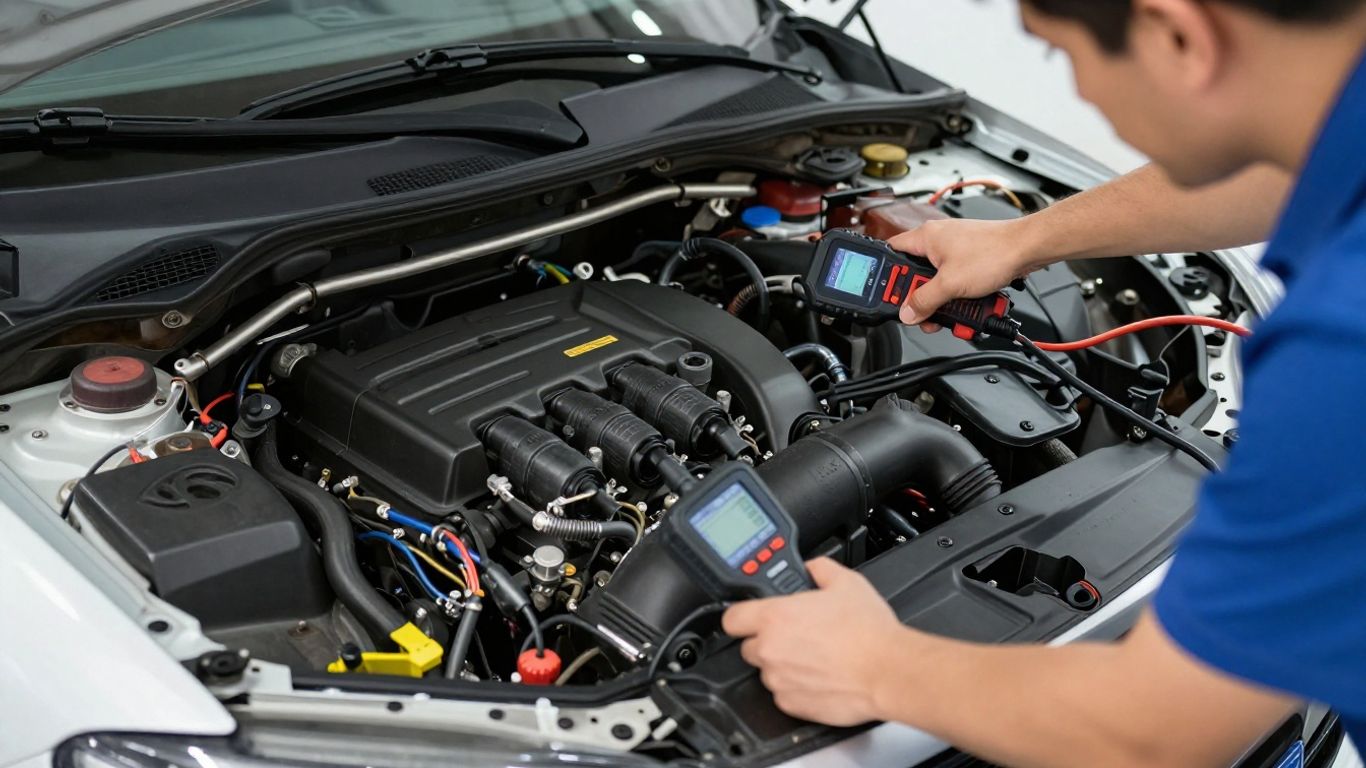
On a petrol engine, worn spark plugs, a weak ignition coil, or damaged wiring can interrupt combustion. A misfire may be felt as vibration or hesitation, though a single-cylinder fault can be subtle. Inspect plug condition and coil connections, then use appropriate tests to determine whether the fault follows a component or stays with the cylinder.
Air and fuel problems involving sensors and injectors
Unmetered air, a contaminated air-measurement sensor, restricted fuel delivery, or an injector problem can upset combustion. Fuel-trim readings, intake inspection, pressure testing, and injector checks are more useful than replacing the first sensor named by the code. Recent fuelling work should be mentioned because disturbed connectors and seals are common clues.
Emissions faults from the oxygen sensor or catalytic converter
An oxygen-sensor code may reflect the sensor, its heater circuit, an exhaust leak, or an engine that is running incorrectly. A catalytic-converter efficiency code should prompt checks of misfires, fuel mixture, exhaust leaks, and sensor signals before the converter itself is condemned. The warning light is often reporting the result of a problem that began elsewhere.
Turbocharger, diesel particulate filter, and exhaust gas recirculation issues
Diesel engines may develop faults involving the EGR system, particulate-filter loading, boost control, or related pressure and temperature sensors. Petrol turbo engines can also show boost-related warnings caused by hoses, valves, wiring, or leaks rather than the turbocharger. Reduced power is a reason to drive gently and arrange diagnosis, particularly if smoke or abnormal noise is present.
Battery voltage and wiring faults that trigger false warnings
Low system voltage during starting can create several apparently unrelated codes. Corroded terminals, poor grounds, damaged harnesses, and loose connectors can produce the same effect. Check battery and charging voltage under suitable conditions, then inspect the circuit before assuming multiple components failed together.
Use fault codes to narrow down the repair
Codes become valuable when they are treated as test instructions. Look for patterns across cylinders, sensors, operating conditions, and freeze-frame data. The goal is to explain why the computer saw the fault, not simply to make the dashboard light disappear.
What misfire codes can reveal about engine operation
A cylinder-specific misfire code helps focus inspection on that cylinder, while a random or multiple-cylinder code suggests a shared cause such as fuel supply, air measurement, ignition power, or low voltage. Compare live misfire counts if available and check whether the fault appears at idle, under load, or during warm-up. Test before replacing parts is the rule that prevents many expensive detours.
How lean and rich mixture codes guide testing
A lean code can lead you toward an intake leak, inadequate fuel delivery, or inaccurate air measurement. A rich code may call for checks of fuel pressure, injector leakage, air sensing, and exhaust feedback. Use fuel trims at different engine speeds: a change between idle and a raised speed can help distinguish an intake leak from a broader fuelling problem.
Interpreting oxygen sensor and catalytic converter codes
An oxygen-sensor circuit code points first toward wiring, power, ground, heater resistance, or the sensor itself. An efficiency code compares the behaviour of oxygen sensors around the catalyst and should be investigated alongside mixture and misfire evidence. Replacing a catalyst without correcting an over-fuelling or misfire condition risks a repeat failure.
Checking sensor readings instead of replacing parts immediately
Compare live data with engine temperature, throttle position, load, and the conditions recorded in freeze-frame information. A reading that is implausible when compared with related sensors can identify a wiring or reference-voltage problem. This is where a workshop’s electrical testing often matters more than the price or brand of a replacement sensor.
Renault-specific diagnosis considerations
A useful diagnosis accounts for the engine type, model generation, maintenance history, and control modules fitted to the car. Similar dashboard wording can arise from different systems on different vehicles. Model-specific service information is especially helpful when a basic scanner gives only a broad description.
Differences between petrol and diesel engine faults
Petrol faults often centre on ignition, air-fuel mixture, throttle control, and evaporative systems. Diesel diagnosis may involve glow plugs, injection pressure, EGR, turbo control, particulate-filter regeneration, and exhaust after-treatment. The same symptom, such as reduced power, can therefore lead to very different tests.
Common issues on Renault Clio, Megane, Captur, and Scenic models
These model names cover multiple generations and engine families, so a diagnosis cannot safely be based on the badge alone. Confirm the engine code, fuel type, year, and transmission before ordering parts. A guide covering Clio, Megane, Captur, and Scenic faults can provide useful orientation, while the actual vehicle configuration determines the next test.
When Renault-specific software is more useful than a basic scanner
A basic scanner may be enough for generic engine codes, but manufacturer-level software can access additional modules, data values, tests, and configuration information. It is particularly useful when the warning involves several control units, a recurring communication fault, or a code that lacks enough detail for a reliable circuit test. Use the tool to improve diagnosis, not to skip it.
How service history and previous repairs affect diagnosis
Recent battery replacement, engine work, sensor replacement, or software updates can explain when a warning began. Ask whether the fault appeared immediately after servicing, refuelling, or a component change. A complete history narrows the search and helps distinguish a new defect from an unresolved original problem.
Decide on the repair and prevent the warning light from returning
The final repair should address the cause established by testing, not just the code’s wording. That may mean repairing a connector, replacing a worn ignition part, cleaning a system, or correcting a mechanical problem. Consider the vehicle’s age and condition, but do not trade away safety for a cheaper guess.
When to replace a component versus repair wiring or connections
Replace a component when its operation fails a suitable test and the power, ground, signal, and mechanical conditions are sound. Repair wiring or connections when testing shows an open circuit, short, corrosion, poor terminal tension, or damaged insulation. A new part cannot compensate for a failed ground or broken signal wire.
How to verify a repair with a follow-up scan and road test
After the repair, clear codes only after recording the original evidence, then run the engine and check for immediate returns. Complete a controlled road test that includes the conditions associated with the original fault, while monitoring temperature, performance, and live data where possible. Rescan afterward and confirm that readiness and warning-light behaviour are appropriate.
Typical diagnostic and repair cost factors
The bill depends on diagnostic time, access to the failed part, parts pricing, labour rates, and whether further testing is needed. A wiring fault can take longer to locate than a straightforward plug replacement, while a catalyst or turbo-related repair may involve surrounding causes as well. Ask whether the estimate includes scanning, testing, parts, labour, and a post-repair check.
A careful diagnostic process has more in common with a structured Revenue Engine than with guesswork: define the signal, find the leak in the process, and verify the result. That comparison is only about method; vehicle repairs still require automotive testing.
Maintenance steps that reduce recurring engine warning faults
Keep to the service schedule, use suitable fluids and filters, address rough running promptly, and investigate repeated low-voltage events. Do not ignore a light simply because it turns off. If you need to organise unrelated household plans while the car is in the workshop, Travel FX and Synergy Oviedo Chiropractic are examples of separate services—not automotive repair resources—and should not be confused with vehicle diagnosis.
Conclusion
Renault engine warning light diagnosis is most reliable when the driver records the symptoms, preserves the fault codes, and confirms the suspected cause with testing. A steady light may allow a cautious trip, but flashing lights, severe symptoms, or red warnings call for immediate action. Once the repair is made, a follow-up scan and road test help ensure the warning does not simply return.
Frequently Asked Questions
Can I drive with the engine warning light on?
A short, gentle drive may be reasonable if the light is steady, the engine runs normally, and no serious warning appears. Do not continue driving if the light flashes, the engine misfires badly, the temperature rises, or power drops sharply.
Does a check-engine light always mean an expensive repair?
No. The cause may be a loose connection, low voltage, an air leak, or a relatively simple ignition fault. The cost cannot be estimated responsibly until the code and the failed circuit or component are confirmed.
Should I disconnect the battery to turn the light off?
It is better not to use battery disconnection as a substitute for diagnosis. It can erase useful data and reset readiness monitors, while the original fault may return later.
What is the difference between a stored and pending code?
A stored code usually describes a confirmed fault event. A pending code indicates that the computer has noticed a condition but may not yet have met the criteria to confirm it fully.
Can a bad battery cause an engine warning light?
Yes. Low voltage during starting or unstable charging can create misleading communication and sensor codes. Battery, charging, and ground checks are sensible when several unrelated warnings appear together.
Will a warning light turn off after a repair?
It may turn off after the computer confirms that the condition is no longer present, but some systems require a scan to clear a confirmed code. A proper repair should still be verified with a rescan and road test.
Is an OBD2 code enough to identify the failed part?
Usually not. A code identifies a monitored condition or circuit area, and the same code can result from wiring, air leaks, low voltage, mechanical problems, or the named component itself. Testing is needed before replacement.