

Key Takeaways
Starting problems can come from the battery, its connections, the starter circuit, the charging system, or damaged wiring. A few careful checks can narrow the cause, but repeated symptoms call for a measured diagnosis rather than guesswork.
- Clicking or slow cranking can point to low battery power, a poor connection, or a starter fault.
- Check battery condition alongside terminals, cables, and ground connections.
- A running engine does not rule out a charging problem; the alternator and its connections matter too.
- Compare symptoms and test results before replacing parts.
- Seek professional help when electrical faults persist, recur, or are difficult to test safely.
Recognizing common electrical and starting symptoms
A car that will not start is giving you a symptom, not a diagnosis. The sound it makes, the behavior of the lights, and whether the problem comes and goes can help narrow down where to look. Note what happens before trying repeated starts, since each attempt can further drain the battery.
Clicking, slow cranking, or no response when turning the key
A rapid series of clicks often occurs when there is not enough power reaching the starter, though a loose or corroded connection can create a similar result. One solid click with no engine movement may point toward the starter circuit or motor, while slow cranking is commonly associated with a weak battery, poor connections, or a starter drawing too much current. If turning the key produces no response at all, consider the battery connections and control circuit as well as the starter itself.
Dim lights and other signs of low voltage
Headlights that dim noticeably during a start attempt may be reacting to a drop in available voltage. Flickering cabin lights, sluggish accessories, or electronics that reset can add useful clues, but none identifies the failed component on its own. Compare what happens with the engine off and running, and remember that a weak battery or poor connection can affect several systems at once.
Intermittent starting problems and dashboard warning lights
A vehicle that starts normally one day and struggles the next may have a marginal connection, a battery nearing the end of its useful life, or a fault affected by heat or vibration. Pay attention to warning lights and note whether they appear before, during, or after a difficult start. A recurring pattern matters: recording when the issue occurs can help distinguish a one-off low charge from a fault that needs testing.
Checking the battery and its connections
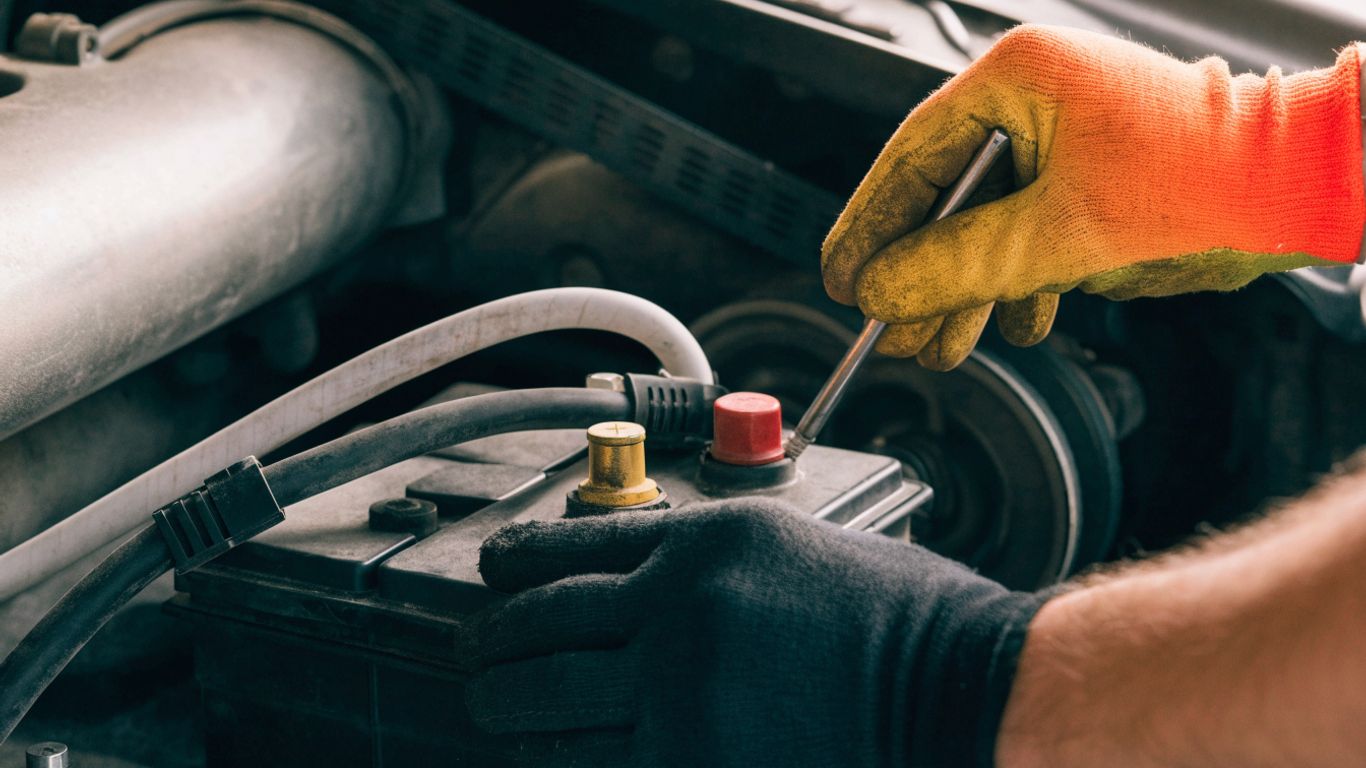
The battery is a practical place to begin because it supplies the power needed to crank the engine and supports electrical systems when the engine is off. A visual check can reveal obvious damage, but it cannot confirm battery capacity or rule out a charging problem. Look at the battery and its connections before deciding that the battery itself needs replacement.
Testing battery voltage and overall condition
A multimeter can provide a useful voltage reading, but voltage alone does not show how well a battery performs under load. A battery test can assess its condition more directly, especially when starting has become unreliable or the battery has been repeatedly discharged. If you do not have suitable equipment or are unsure how to test safely, a repair professional can check it with appropriate tools.
Different observations point toward different next steps, so it helps to read a voltage check in context rather than treat one number as a verdict. The table below gives a simple guide to what common findings may suggest; vehicle specifications and test conditions still matter.
| Observation | Possible meaning | Useful next check |
|---|---|---|
| Low resting voltage | Battery may be discharged or deteriorating | Charge and test battery condition |
| Voltage drops sharply during cranking | Battery may be weak, or the starter may draw excessive current | Test the battery and starter circuit |
| Battery tests well, but cranking is slow | Connection, cable, ground, or starter fault is possible | Inspect connections and check voltage drop |
| Warning light appears while driving | Charging system may need inspection | Test alternator output and connections |
After a charge, retest rather than assuming the problem is resolved. If the battery repeatedly loses charge, investigate why: the cause may be a charging fault, a poor connection, or another electrical draw.
Inspecting terminals, cables, and ground connections
Look for loose clamps, corrosion, cracked insulation, frayed cable strands, and signs of heat around the battery terminals. A connection can look acceptable from above yet still have enough resistance to interfere with starting. Check the ground path as well as the positive cable, since the starter circuit depends on a complete electrical route.
A careful inspection can follow a short sequence:
- Switch the vehicle off and remove the key before inspecting connections.
- Look for corrosion, looseness, damaged insulation, or a cable that moves at its terminal.
- Check visible ground connections for looseness or damage.
- Arrange cleaning or repair if a connection is heavily corroded or damaged.
Do not bridge terminals with a tool or handle a battery if it is cracked, leaking, or swollen. When connection work is complete, a fresh start attempt can show whether the symptom has changed, but a change does not always establish the root cause.
Considering battery age, temperature, and driving habits
Battery performance can be affected by age, extreme temperatures, and repeated short trips that leave little time for the charging system to replenish its charge. Accessories used while the engine is off may also contribute to a low charge. Think about whether the trouble began after a cold snap, a long period parked, or a change in driving routine.
A battery that has been discharged several times may need more than a jump-start to determine whether it remains serviceable. Australia’s trusted Car Parts Supplier connects customers with quality used, genuine, and aftermarket parts; match any replacement to the vehicle’s specifications and the part required. The business provides parts, not a diagnosis of the starting fault, so testing remains important before ordering.
Understanding starter and ignition system faults
If the battery is charged and its connections are sound, move on to the components that carry the start command and turn the engine. The starter system includes both high-current components and controls, so a fault can arise at more than one point. Listening carefully and testing the circuit can prevent replacing a sound part.
How the starter motor and solenoid work
When the driver turns the key or presses the start button, the vehicle’s control circuit signals the starter solenoid. The solenoid engages the starter mechanism and allows electrical current to reach the motor, which turns the engine until it can run on its own. A click may mean the solenoid is responding, but it does not prove the motor, cables, or battery can complete the job.
Different vehicles control this process in different ways, and some starting systems have additional safety interlocks. A faulty connection or control signal can therefore resemble a failed starter. For a related application, backup starting systems in generator sets also depend on components such as batteries and chargers.
When to check the ignition switch and relays
If there is no response when the start control is used, the fault may lie in the control side of the circuit rather than in the starter motor. Depending on the vehicle, the ignition switch, a relay, a safety interlock, or wiring may prevent the starter from receiving the command. A relay that clicks is not necessarily functioning correctly under load, so testing is more reliable than sound alone.
Use the vehicle’s manual to identify the correct fuse and relay locations, and avoid substituting parts without checking their ratings and purpose. If the starter works only intermittently or the fault changes when the key is moved, have the control circuit inspected rather than repeatedly forcing the start attempt.
Distinguishing starter failure from a weak battery
A weak battery and a failing starter can both cause slow cranking, which is why replacing one based only on that symptom can be a costly guess. A battery test, connection inspection, and starter-current or voltage-drop checks help separate the possibilities. If the lights remain bright but the engine barely turns, that is a clue to investigate, not proof of a specific failure.
Look for consistent test results across more than one start attempt. If the battery passes testing and the cables and grounds are sound, a technician can focus on the starter and its control circuit. If the battery fails a proper test, confirm that the charging system is also working so a replacement is not exposed to the same problem.
Diagnosing charging system problems
The charging system helps maintain the battery’s charge while the engine runs and supplies power to vehicle electrical equipment. A battery that repeatedly goes flat may be the victim of a charging fault rather than the original cause. Testing the system as a whole is more useful than replacing the battery and hoping the issue disappears.
How the alternator replenishes the battery
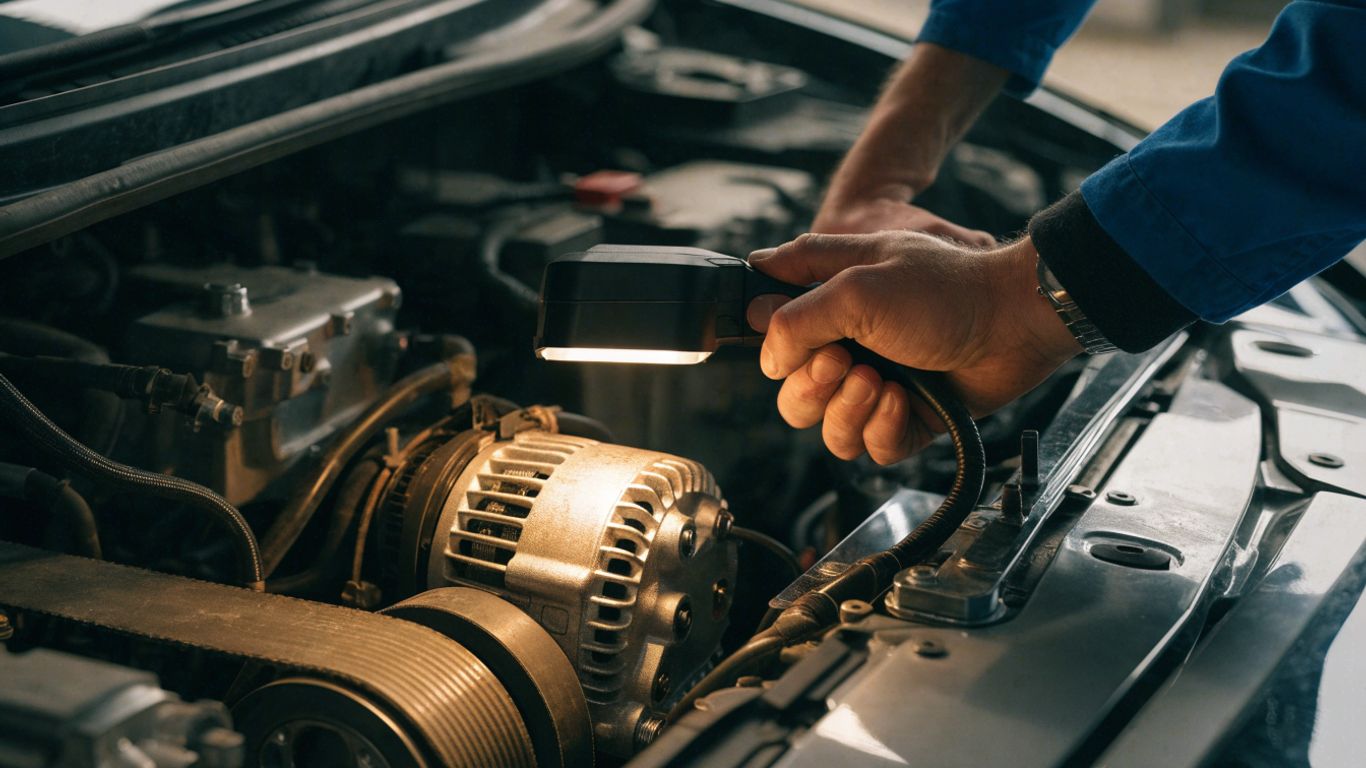
Once the engine is running, the alternator produces electrical power that supports the vehicle’s systems and replenishes the battery. The drive belt turns the alternator, while wiring and connections carry its output. A fault in any part of that path can leave the battery undercharged even if it can still start the car for a while.
A charging-system test compares system output with the vehicle’s requirements under the test conditions. Readings should be interpreted according to the vehicle, since modern charging controls can vary output. Avoid assuming that a battery warning light or a single voltage measurement identifies the alternator as the failed part.
Identifying signs of undercharging or overcharging
Repeated low battery charge, dim or fluctuating lights, and a battery warning light can be reasons to test the charging system. Overcharging can also cause problems and may be accompanied by unusual battery behavior or electrical issues. These signs overlap with other faults, so they are prompts for diagnosis rather than a basis for immediate replacement.
If a warning appears while driving, reduce unnecessary electrical use when safe and arrange an inspection. Do not continue driving if the vehicle is losing electrical functions or appears unsafe. A proper test can check alternator output and related connections before a repair decision is made.
Checking the drive belt and charging system connections
With the engine switched off, look for a visibly damaged or loose drive belt and inspect accessible charging-system wiring for looseness or corrosion. Do not reach near moving belts or fans, and do not attempt adjustments while the engine is running. Belt tension and replacement procedures vary, so use the vehicle’s service information or ask a qualified repairer if the condition is unclear.
Connections can limit charging even when the alternator itself is serviceable. A technician can test the alternator output and the cables under appropriate conditions, then determine whether the belt, wiring, or another component needs attention. That sequence keeps the diagnosis focused on the fault rather than the most familiar part.
Finding wiring and electrical faults
Vehicle wiring distributes power and control signals across many interconnected components. A damaged wire, poor ground, or corroded connector can produce symptoms that appear unrelated, including intermittent starting trouble and flickering lights. Work methodically, beginning with visible damage and moving to electrical tests when needed.
Tracing damaged wires, loose connectors, and corrosion
Inspect accessible wiring for cuts, abrasion, melted insulation, loose plugs, or corrosion around connectors. Pay extra attention to areas exposed to movement, heat, moisture, or previous repairs. Do not pull hard on a wire or disconnect components without knowing the vehicle’s correct procedure; modern vehicles can have sensitive electronic systems.
When symptoms come and go, a technician may need to test while carefully checking the affected harness and connectors. A fault that changes with vibration or movement can be difficult to catch in a quick visual inspection. Record when the trouble happens and what systems are affected to help narrow the search.
Checking fuses and relays safely
A blown fuse can interrupt power to a circuit, but replacing it without finding why it failed may only restore operation briefly. Consult the owner’s manual for the correct fuse location and rating, and switch the vehicle off before inspecting it. Never install a higher-rated fuse or bypass a fuse with improvised material.
If a replacement fuse blows again, stop and have the circuit checked for a short or another fault. Relays can also fail, but swapping them is only appropriate when the manual confirms the parts are identical and the procedure is suitable for that vehicle. Careful handling helps prevent a small electrical issue from becoming a larger one.
Using a multimeter to locate voltage drops
A voltage-drop test checks how much electrical pressure is lost across a cable or connection while current is flowing. It can reveal resistance in a circuit that looks clean and intact from the outside. Because the test usually involves a start attempt and access to electrical connections, use correct test points and follow the meter and vehicle instructions.
An unexpected reading helps direct attention to the section of circuit being tested; it does not automatically identify a part to replace. If you are unfamiliar with meter use, or cannot safely reach the required connections, leave the test to a professional. Repeated short checks with proper equipment are better than probing random wires.
Choosing repairs and preventing repeat failures
Once testing points to a likely cause, the next decision is whether a component can be repaired or should be replaced. Consider the test results, visible condition, part fitment, and whether another fault could damage the replacement. A reliable repair addresses the underlying problem rather than only clearing the immediate symptom.
Deciding whether to test, repair, or replace a component
Begin with the evidence: battery and charging tests, connection condition, and symptoms during the start attempt. Some issues are as simple as a loose connection; others require component replacement or further electrical diagnosis. Check vehicle-specific fitment and specifications before sourcing a part, since similar-looking components may not be interchangeable.
Australia’s trusted Car Parts Supplier connects customers with quality used, genuine, and aftermarket parts through a car parts network. For drivers comparing options, the right choice depends on vehicle compatibility, part condition, and the requirements of the repair. A part supplier can help customers find parts; confirming the fault and installing them are separate steps.
When professional electrical diagnosis is worthwhile
Professional diagnosis is worthwhile when a fault keeps returning, a fuse repeatedly blows, warning lights remain on, or a test requires access to difficult or hazardous connections. It is also sensible when the vehicle has multiple electrical symptoms or when replacing a part has not changed the behavior. A technician can check connected systems instead of treating each symptom as a separate failure.
For another starting-system reference, generator starting components provide a useful reminder that batteries and chargers matter in backup equipment too. The vehicle itself still needs diagnosis using its own specifications and test procedures. Do not attempt repairs around damaged, leaking, or swollen batteries.
Maintaining the battery and connections to reduce future issues
Regular visual checks and attention to changes in starting speed can help catch trouble before the vehicle will not start. Keep terminals and cables secure, avoid leaving electrical accessories on unnecessarily, and follow the battery maker’s care guidance. If a battery repeatedly discharges, investigate the charging system or an electrical draw instead of relying on repeated jump-starts.
Replacement sourcing is only one part of maintenance. Australia’s trusted Car Parts Supplier connects customers with quality used, genuine, and aftermarket parts across its network, while the vehicle’s needs should guide any purchase. For readers researching separate projects, this site also has information on local business marketing, roof replacement decisions, financial residency routes, home solar battery safety, and small-business tools.
Conclusion
Starting and charging problems are easier to solve when symptoms guide careful testing rather than guesswork. Check the battery and its connections, consider the starter and charging system, and inspect wiring safely; if results are unclear or faults return, a professional diagnosis can help prevent unnecessary parts replacement.
Frequently Asked Questions
Why does my car click but not start?
Clicking can result from a weak battery, a poor connection, or a starter or solenoid fault. Testing the battery and inspecting its cables are useful first steps, but the sound alone cannot confirm the cause.
Can a bad battery cause dim headlights?
Yes, low battery charge or a poor connection can contribute to dim lights. Charging-system problems and wiring faults can produce similar symptoms, so testing is needed to distinguish them.
How can I tell whether the battery or starter is faulty?
A battery test, inspection of the terminals and grounds, and checks of the starter circuit can help separate the causes. Slow cranking by itself is not enough to identify which component has failed.
Will driving recharge a dead battery?
The alternator can replenish a battery while the engine runs, but a deeply discharged or deteriorated battery may not recover adequately. If the battery repeatedly goes flat, check both its condition and the charging system.
What does a battery warning light mean?
It can indicate a charging-system problem, but it does not identify a specific failed part. Have the alternator, belt, wiring, and related connections tested.
Is it safe to check a car battery myself?
A basic visual inspection may be reasonable if you follow the vehicle’s safety guidance and avoid damaged batteries or exposed electrical hazards. Do not bridge terminals with tools, and seek help if you are unsure.
Why do starting problems happen only sometimes?
Intermittent faults may be affected by temperature, vibration, a loose connection, or a component that is beginning to fail. Note when the problem occurs and have recurring symptoms tested before they become a no-start condition.